Of all the complaints a schedule can generate, the quietest but deepest is the sense of unfairness.
"Why does she always get the good shifts?" "Why am I the only one getting overloaded?" Once these start, they slowly poison the mood of the whole team.
The tricky part: the person building the schedule can't see their own bias. With no ill intent, work drifts toward whoever's easiest to ask. Shiftaru handles this drift by design, not by discipline.
🎉 Now live
Shiftaru is officially live. The free practice mode (sample data) needs no signup.
👉 https://shiftaru.com
Unfairness comes from unconscious bias
Build a schedule by hand and, inevitably —
- work drifts to the people who are easy to ask and rarely say no
- you keep slotting in the same experienced hands
- you can't track, across everyone, who's picked up how many shifts
Tallying each person's total in your head while you build doesn't scale — the more people you have, the harder it gets. Bias creeps in, and bias turns into resentment.
Shiftaru lets you choose how work is distributed
When Shiftaru runs the match, you pick the distribution policy:
- Spread mode: push work across as many staff as possible (cap the number of shifts per person)
- Concentrate mode: pack shifts onto fewer people (when you'd rather run lean)
Same availability, same shift data — change the policy and the finished schedule changes with it.
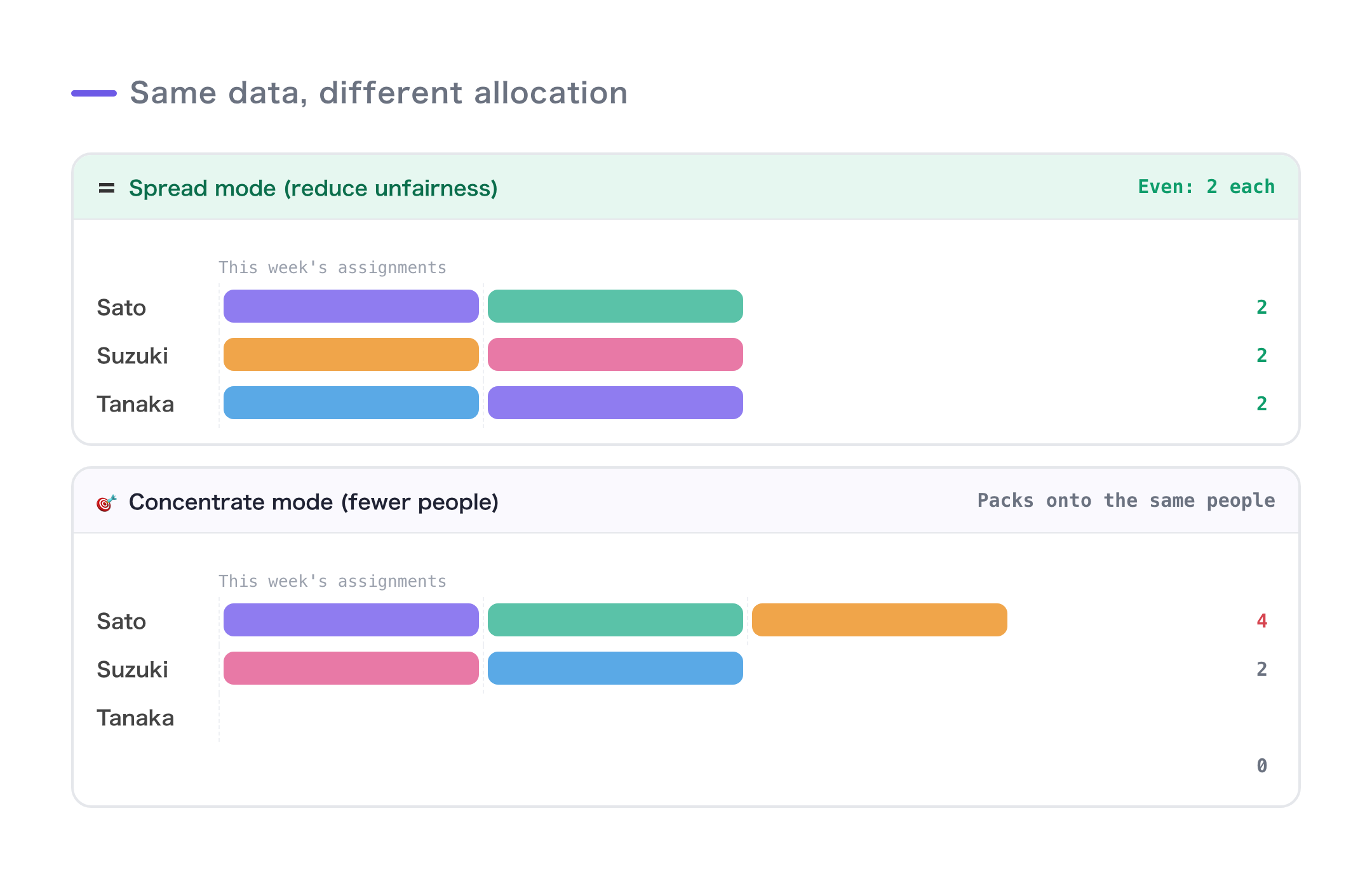
Want to kill the unfairness? Use Spread. Need to keep a slow day staffed by just a few people? Use Concentrate. Switch based on your goal.
Cap "too many shifts" with hard limits
Even with work spread out, you still want to prevent plain overwork. Shiftaru lets you set caps:
- max bookings per day
- max working days per week / per period
- max consecutive slots someone can be assigned
These act as hard caps, so "wait, this person is way overloaded" gets stopped by the system, not caught after the fact. You can also set them per staff member in the master list.
Because it's driven by rules, you can explain it
When assignments are decided mechanically, you get another benefit: you can explain why the schedule looks the way it does.
"Spread mode, within the caps, matching whoever fits the conditions in order" — a clear rule means people accept a bit of imbalance far more easily. It reads as fair, in a way that a hand-built "just felt right" never does.
In short
- Unfairness comes from the unconscious bias of hand-building schedules.
- Shiftaru lets you choose a distribution policy — Spread or Concentrate (use Spread to fight unfairness).
- Daily counts, weekly/period working days, and consecutive slots all have caps to stop overwork.
- Because the rule is clear, you can explain the allocation — and people accept it.
"Why does she always get the good shifts" isn't a problem of attention. It's a problem of settings. Start by building your next schedule in Spread mode.
- ▶ https://shiftaru.com — free practice mode, no signup
- ▶ Read more: Shiftaru Blog