When you let software build a schedule, it happily assigns anyone who fits the conditions — fast and convenient. The flip side: leave it unchecked and the same few people get loaded up. For labor rules and for retention alike, that's not something you can afford to shrug off.
Shiftaru, a shift and booking auto-matching app, lets you set working-hour caps up front, so "too many shifts" gets stopped by the system instead of by willpower.
🎉 Now live
Shiftaru is officially live. The free practice mode (sample data) needs no signup.
👉 https://shiftaru.com
You notice overwork too late
By hand or by software, overwork is hard to see while you're in the middle of building. Add one booking at a time and the running total stays invisible. By the time it clicks, it's already "wait — Alex is on for six days this week."
So instead of counting each shift to prevent it, the reliable move is to decide the ceiling first and make the machine hold the line.
Four caps you can set in Shiftaru
Shiftaru enforces the following as hard caps — no assignment is ever created that exceeds them.
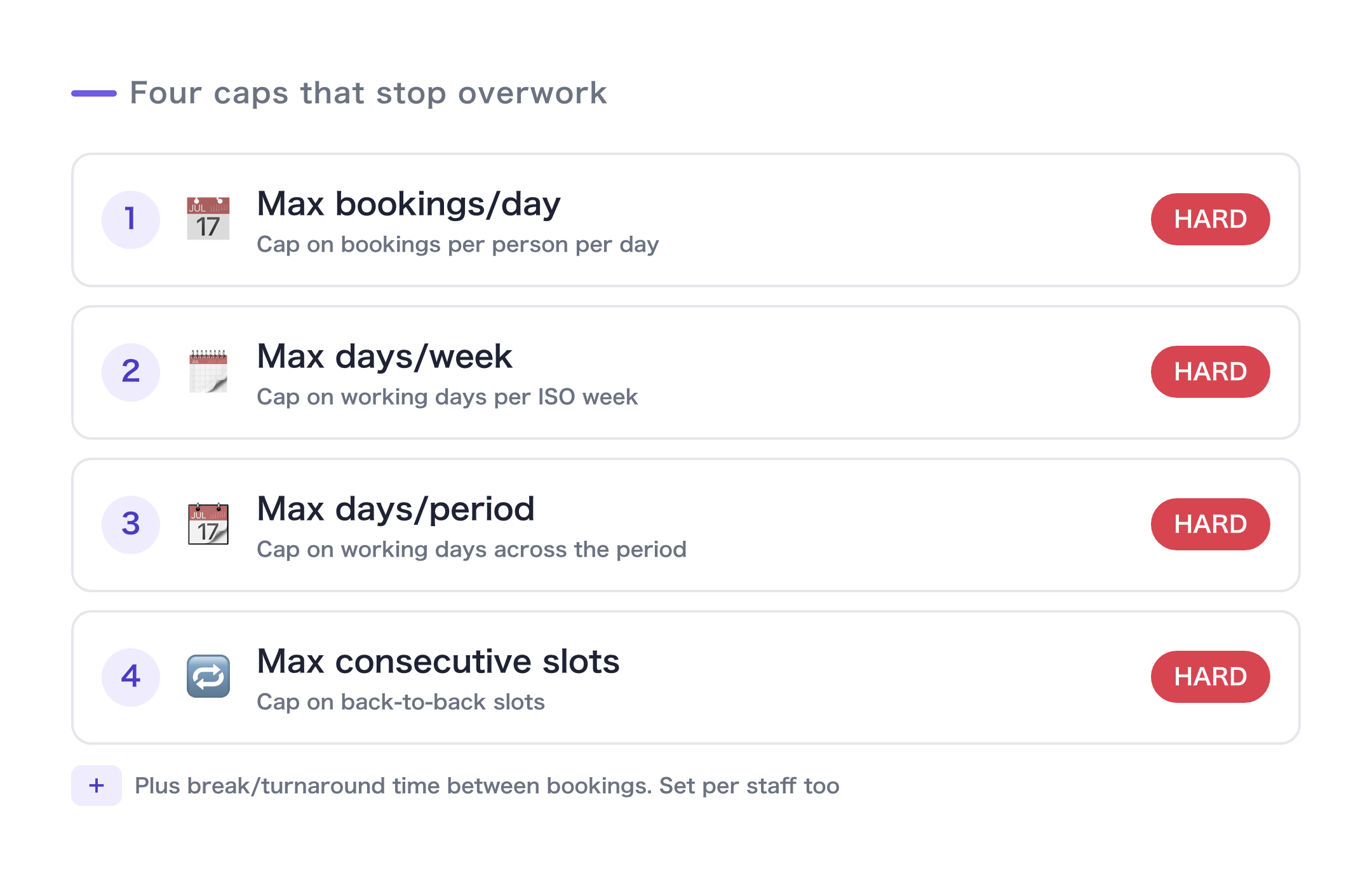
- Max bookings per day — the ceiling on how many bookings one person can hold in a single day
- Max working days per week — the ceiling on days worked in a week (counted by ISO week)
- Max working days per period — the ceiling on days worked across the whole target period
- Max consecutive slots — the ceiling on how many slots someone can be assigned back-to-back without a break
On top of that, the break / turnaround time between bookings is protected too. And every one of these can be set per staff member, so rules like "students up to 3 days a week, full-timers up to 5" are easy to run.
Pair it with Spread mode
A cap is a ceiling — "no more than this." What keeps work from piling up in the first place is Spread mode (push work across as many staff as possible).
- Spread mode keeps the everyday allocation even
- Caps set the ceiling so nobody goes over even then
Use the two together and you get a schedule where no single person gets buried, and nobody works too much. (For more on designing fairness, see this post.)
When a cap blocks an assignment, you see why
If the caps are tight enough that something can't be assigned, Shiftaru doesn't hide it. Whatever couldn't be matched shows a reason — like "cap reached." That gives you what you need to decide: raise the cap, or add people? Far healthier than cramming everything in and watching it fall apart later.
In short
- Overwork is hard to see while you're building. Setting the ceiling first and letting the machine hold it is the reliable way.
- Shiftaru enforces ① bookings per day ② working days per week ③ working days per period ④ consecutive slots, plus break time, as caps.
- Caps can be set per staff member, and paired with Spread mode they prevent both lopsided and excessive schedules.
- Whatever the caps block comes back with a reason, so you can decide whether to add staff or adjust.
Building fast, and letting people work without burning out. Working-hour caps are how you get both.
- ▶ https://shiftaru.com — free practice mode, no signup
- ▶ Read more: Shiftaru Blog