Scheduling for a home care or in-home nursing agency is not like scheduling a store.
Service areas. Required certifications. Multiple visits per caregiver per day. Drive time between clients. No double-booking. Daily and weekly caps. Stack those conditions together and a spreadsheet stops being enough — usually around the point where you have more than a couple of dozen visits a week.
And the data you're moving around is sensitive: client names, home addresses, care details.
Shiftaru was built to handle both problems at once — the complexity and the privacy.
🎉 Now live
Shiftaru is officially live. The free practice mode (sample data) needs no signup.
👉 https://shiftaru.com
Why it becomes a puzzle every single week
To place one visit, a scheduler is holding several conditions in their head simultaneously:
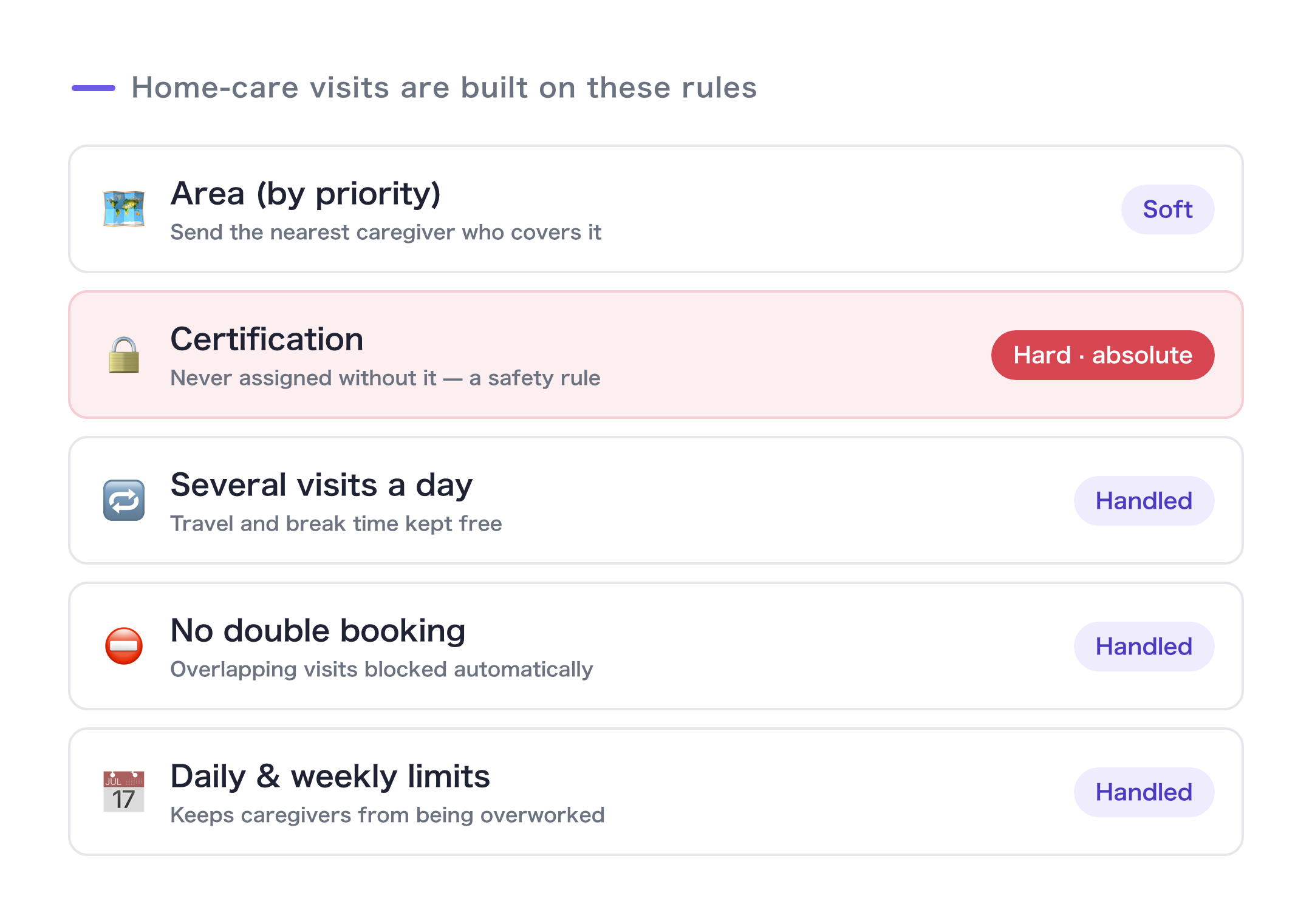
- Can this caregiver cover the client's service area?
- Do they hold the required certification or license?
- How many visits do they already have that day (multiple visits per day is the norm)?
- Is there enough time between visits for travel and breaks?
- Are they still under their daily and weekly limits?
Now repeat that for every client on your roster — every week.
The hard part isn't the first pass. It's that one change cascades. A caregiver calls out sick, a client moves a visit an hour, and half the board has to be rebuilt. Last week's schedule is worthless as a starting point, so you begin from scratch again.
Home care scheduling is heavy not because your coordinator is slow. It's because the number of conditions is genuinely beyond what a person can hold at once. (More on that in Part 1.)
Shiftaru schedules with your real-world rules
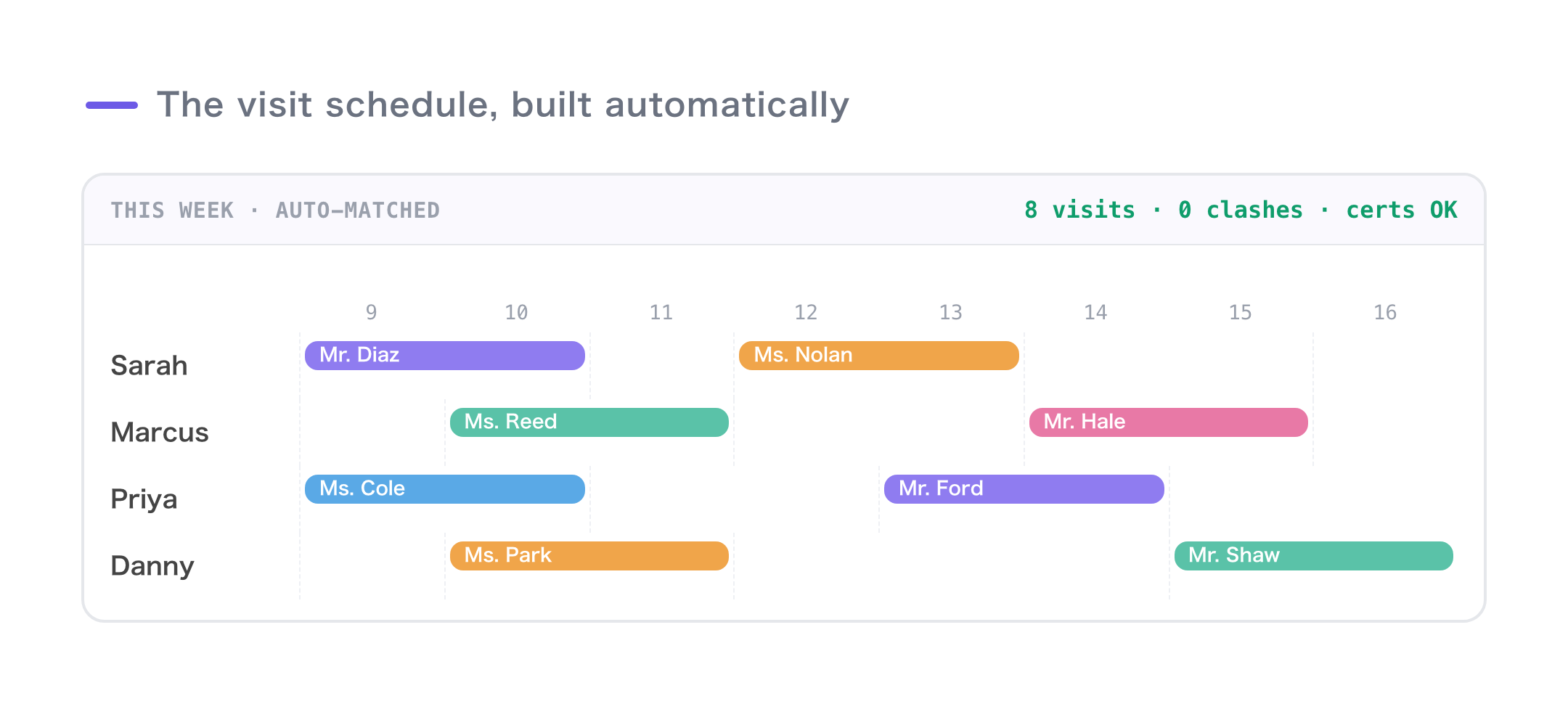
Shiftaru takes those same conditions and matches automatically:
- Service area, in priority order — caregivers who can actually cover the client's location, closest first
- Multiple visits per day — several visits per caregiver, with travel and break time reserved between them
- No double-booking — overlapping visits are prevented automatically
- Daily and weekly caps — nobody gets overloaded
Hundreds of visits resolve in seconds. "Someone called out, rebuild the week" takes one click.
(The matching engine itself is explained in Part 2.)
Certifications are a hard constraint. Always.
Certification is the one thing you cannot get wrong in home care. It isn't a nice-to-have preference — it's a safety and compliance requirement.
So Shiftaru treats it differently from everything else. Service area is a soft priority: a better area match scores higher, but a caregiver who's a little farther out can still be assigned if that's the best available option. Certification is a hard constraint: a caregiver who doesn't hold the required credential is removed from the candidate pool entirely. They will never be assigned, no matter how convenient it would be.
If a visit can't be filled, Shiftaru tells you why — "no certified caregiver available" — so you know exactly where your coverage gap is and who you need to hire or train.
And your client data never leaves the browser
Home care agencies hold some of the most sensitive information there is: names, home addresses, care plans, medical context. That's exactly why Shiftaru's local-first design matters most in this industry.
The client data you load is processed entirely inside your own browser. It is never sent to our servers. Close the tab and it's gone. The finished schedule is saved as a file you control, on your machine.
We can't leak your client list, because we never receive it. (Details in Part 3.)
Summary
- Home care scheduling becomes a weekly puzzle because of area, certifications, multiple visits, and caps — too many conditions to juggle by hand
- Shiftaru matches automatically using your actual rules (hundreds of visits, seconds)
- Certifications are a hard constraint and are never violated; area is a soft priority
- Client data stays in your browser and is never transmitted
Complexity handled by the engine. Privacy handled by the architecture. Both, at once.
- ▶ https://shiftaru.com — free practice mode, no signup
- ▶ Read more: Shiftaru Blog