If you staff multiple stores or restaurants, your scheduling problem runs in the opposite direction from everyone else's.
"Friday night: three people at the downtown location, two at the mall. Do I even have enough availability submitted to cover that? And if I move someone to cover the mall, does downtown open up a hole?"
That's not a matching problem. It's a filling problem — and most people are still doing it by hand, every single week.
Shiftaru fills required headcount automatically.
🎉 Now live
Shiftaru is officially live. The free practice mode (sample data) needs no signup.
👉 https://shiftaru.com
Store shifts run backwards
A photo shoot or a tutoring session is one request, one person. You start from the customer and find someone to assign.
Store shifts invert that. The slot exists first — this store, this time block, this many bodies — and your job is to fill it.
- Which store is the slot at, and who's trained to work there?
- How many people does that slot require (2? 3? 5?)
- Given the availability people actually submitted, can you even hit that number?
- Is anyone accidentally scheduled twice?
- Is one person carrying too much, or blowing past their hour caps?
With ten or twenty open slots, you get the cascade: you fill the downtown store, and now the mall is a person short. You move someone back, and Saturday breaks instead.
The exhausting part isn't any one decision. It's having to keep the entire board in your head while you shuffle people around it.
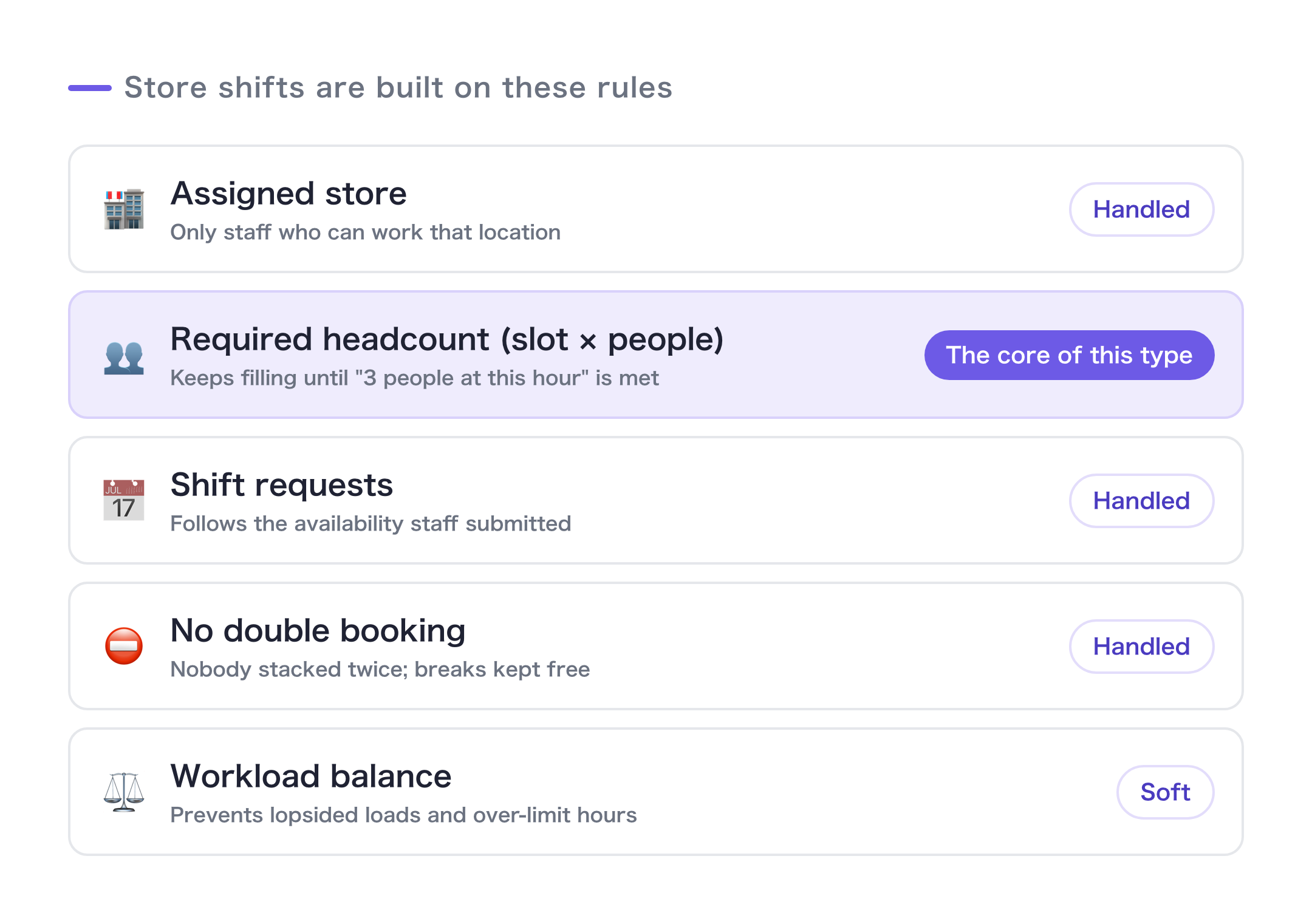
Shiftaru fills the required headcount for you
Shiftaru assigns as many staff as each slot requires, automatically.
- Store assignment — only from staff who can work that location
- Required headcount — if a slot needs 3, it places 3 qualified people
- Submitted availability — it only uses shifts people actually said they could work
- No double-booking — nobody lands in two places at once; travel and break time are reserved
- Workload balance — spread hours across the team, or concentrate them. Your call.
Dozens of slots resolve in seconds. When someone calls out, you get a rebuilt draft immediately.
(The matching engine itself is explained in Part 2. Availability collection via Google Forms is covered in Part 4.)
Gaps are shown, not hidden
The most important thing a store scheduler can do is refuse to hide a hole.
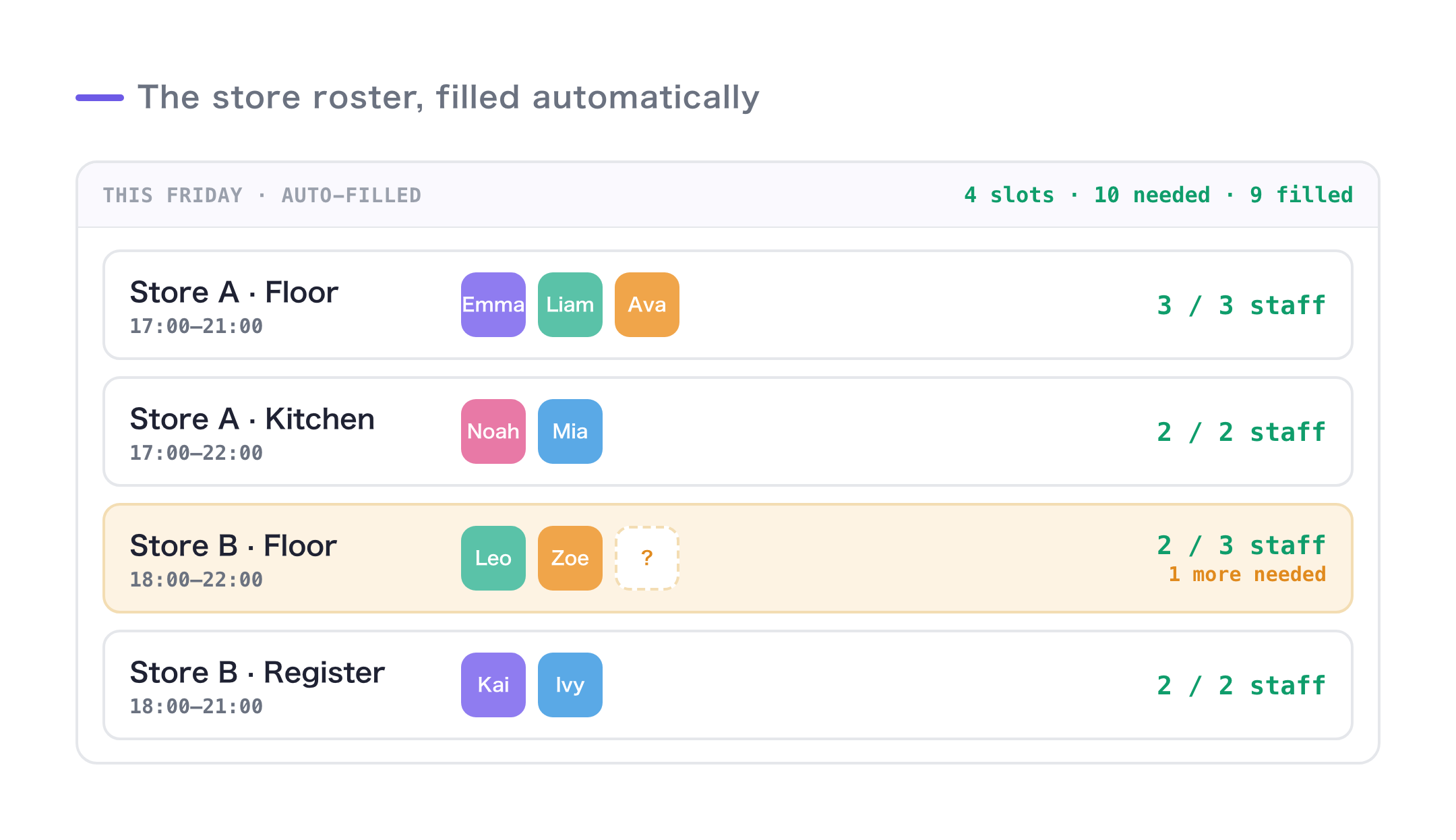
When Shiftaru can fill a slot, it marks it filled. When it can't, it doesn't quietly assign three people to a four-person slot and call it done. It shows you exactly where you stand:
2 of 3 filled — 1 short
So the Friday-night gap surfaces before you publish the schedule, while you still have time to call someone, move a shift, or adjust the requirement. Not at 6pm on Friday.
And your staff data never leaves the browser
Store schedules are built from staff names, contact details, and availability. That's personal data, and it's yours to protect.
The data you load into Shiftaru is processed entirely inside your own browser. It is never sent to our servers. Close the tab and it's gone. The finished schedule is saved as a file you control.
We can't leak your staff list, because we never receive it. (Details in Part 3.)
Summary
- Store scheduling runs backwards: slots come first, and you fill them to a required headcount
- Shiftaru fills each slot to its required headcount automatically (dozens of slots, seconds)
- Shortfalls are shown plainly — "2 of 3 filled — 1 short" — so you catch holes before publishing
- Staff data stays in your browser and is never transmitted
Complexity handled by the engine. Privacy handled by the architecture. Both, at once.
- ▶ https://shiftaru.com — free practice mode, no signup
- ▶ Read more: Shiftaru Blog